


IgA-Albumin Binding Domain (Abd) Fusion Protein Production Service
Background Service Advantages Applications FAQs
Prolonging IgA Persistence through Albumin-Directed FcRn Recycling
One of the primary limitations of IgA antibodies as therapeutic candidates is their inherently short half-life in circulation. At Creative Biolabs, we provide a dedicated IgA-Albumin Binding Domain (Abd) Fusion Protein Production Service that enables indirect FcRn pathway engagement by leveraging the natural recycling mechanism of serum albumin.
By fusing albumin-binding domains (Abd) to IgA molecules, we facilitate interactions with circulating albumin, which in turn interacts with the neonatal Fc receptor (FcRn). This strategy offers a robust solution for enhancing the stability and persistence of IgA constructs in systemic environments—while preserving their native effector functions and mucosal immunity.
Service Highlights
| Modular Abd Fusion Design |
|
| Expression Optimization for IgA-Abd Fusion Constructs |
|
| Integrated Affinity & Biophysical Analysis |
|
| Functional Validation of IgA Activity |
|
Advantages of Our Service
- Non-invasive Half-Life Extension: Leverages the native FcRn-albumin recycling pathway without modifying the IgA Fc directly.
- Broad Species Compatibility: ABDs often retain cross-species albumin binding, enabling use in multiple model systems.
- Maintained IgA Functionality: Fusion design preserves key IgA functions such as FcαRI engagement, mucosal transport, and polymeric structure.
- Modular and Scalable: Suitable for quick screening or larger-scale research production.
Applications
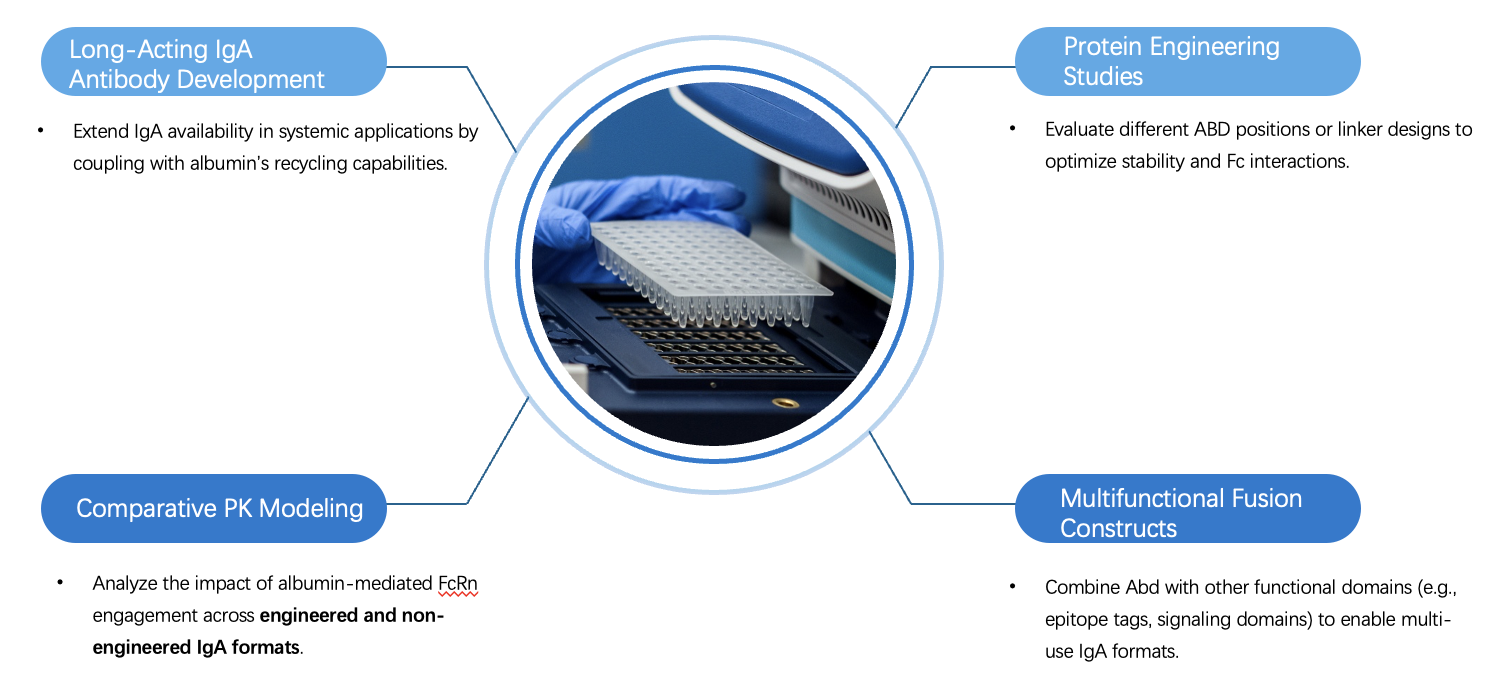
FAQs
Q1: What is the rationale for using albumin binding instead of directly engineering IgA-Fc?
A1: Albumin binding offers a non-disruptive strategy to exploit the FcRn pathway. It avoids direct Fc modifications, thus preserving native IgA glycosylation and effector functions.
Q2: Can I choose a specific albumin-binding domain?
A2: Yes. We offer a panel of ABD variants with different affinities and species reactivity, and can custom-design according to your specifications.
Q3: Will the fusion interfere with antigen recognition?
A3: No. We optimize linker length and fusion site to prevent structural hindrance and validate antigen-binding activity post-expression.
Q4: Do you provide small-scale and mid-scale expression options?
A4: Yes. We support flexible scale expression to accommodate early-stage development, functional screening, or preclinical validation.
For research use only. Not intended for any clinical use.
Send Inquiry
This site is protected by reCAPTCHA and the Google Privacy Policy and Terms of Service apply.
