


IgA Terminal Sialylation Optimization Service
Background Service Advantages Applications FAQs
Enhancing IgA Stability and Circulatory Persistence through Tailored Sialylation Profiles
Sialylation, particularly at terminal N- or O-glycosylation sites, plays a crucial role in modulating IgA antibody stability, solubility, and circulatory lifespan. However, natural IgA—especially when expressed in standard mammalian cell systems—often exhibits incomplete or heterogeneous sialylation, leading to increased aggregation, rapid clearance, and undesirable effector function alterations.
At Creative Biolabs, we offer an expert IgA Terminal Sialylation Optimization Service, leveraging advanced glycoengineering and cell-line modulation technologies to achieve well-controlled, high-fidelity sialylation patterns for both IgA1 and IgA2 isotypes. Our platform enables improved pharmacokinetic behavior and increased resistance to proteolytic degradation, making it ideal for the development of robust IgA antibody products.
Service Highlights
| Customized Cell Line Engineering for Enhanced Sialylation |
|
| Post-Expression Enzymatic Remodeling (Optional) |
|
| Analytical Glycoprofiling and Quality Validation |
|
| Functional Assessment and Aggregation Reduction |
|
Advantages of Our Service
- Improved Solubility & Stability: Terminal sialic acid reduces exposure of hydrophobic glycan cores, improving IgA homogeneity and resistance to aggregation.
- Modulated Effector Functions: Sialylation can subtly modulate IgA's interaction with FcαRI and other immune regulators, providing tuning options.
- Reduced Hepatic Clearance: Lower affinity to asialoglycoprotein receptors (ASGPR) due to completed sialic capping.
- Batch-to-Batch Consistency: Controlled glycoengineering ensures reproducibility for screening and formulation development.
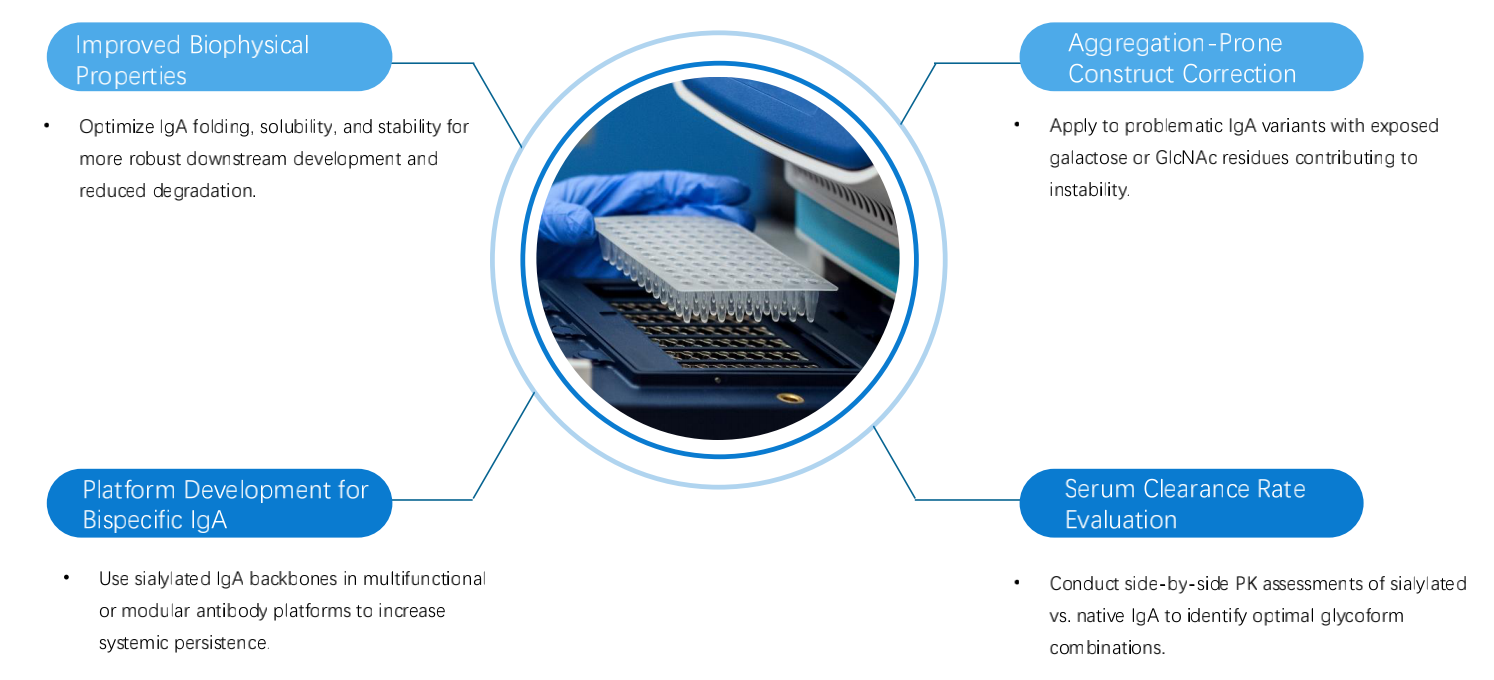
Applications
FAQs
Q1: What's the difference between α2,6- and α2,3-sialylation?
A1: α2,6-linkage is often associated with anti-inflammatory properties and longer persistence, while α2,3-sialylation can influence receptor engagement and immune modulation.
Q2: Can I choose enzymatic or cellular glycoengineering methods?
A2: Yes, we offer both approaches and can recommend based on desired throughput, target structure, and timeline.
Q3: Will sialylation affect antigen binding?
A3: Our optimization process is designed to target Fc or hinge region glycans without altering the antigen-binding domains.
Q4: Is it applicable to polymeric IgA?
A4: Yes. Both monomeric and dimeric IgA can be sialylated efficiently, and we validate structural integrity for each construct.
For research use only. Not intended for any clinical use.
Send Inquiry
This site is protected by reCAPTCHA and the Google Privacy Policy and Terms of Service apply.
